Hilary Mantel Interview: Imaginary Monkey
Peter Breedveld
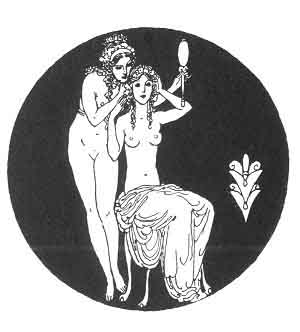
Illustratie: Willy Pogany
An interesting thing in your autobiography Giving up the Ghost is the monkey that your grandparents said they had, which they didn’t, but the monkey came to exist in your mind anyway. So in a sense it was very real.
“What it is, it’s this ambiguity all the time. Even when I was very little, I knew there was no monkey and there never had been. Part of me could know that, and part of me could still believe in the monkey. And I think you have again a really essential precondition for being a writer: hold two separate and contradictory realities. No line ever means just what it says it means. And the more layers of reality you can hold and entertain for your reader, the better and the more the meanings of what you write proliferate. You’re probably right to move in on the monkey story. I think that’s the essence of it: knowing that it is not so, and yet acting as if it is. And that’s how novels are made.”
And how novels are read.
“Exactly. You invite your reader to enter into that world of pretense with you. For the space in which they’re reading the book. A whole world, which makes sense in it’s own terms. When I went to see the psychics working – you look at the audience and you wonder about each of them; why they are there and what their state is. Where are they on the continuum between scepticism and blind faith. They’re all at different points.”
“But for the time we’re sitting there, maybe two hours, we’ve all decided to believe. And so it seemed to me the space of that session with the psychic was just like the space of that novel. For most people, they were just coming to the room, paid their money, talked with the dead and then they would go off and have a drink. And of course that’s mostly what people do after finishing your novel: they close the book, they’re not touched by it, their lives just go on. Occasionally, you hope, there’s something in your novel that stays with people, that will change reality for them. But you never really know whether you achieve that. But you go along in the perfect faith that you can affect reality and make it better. You want to free people’s imaginations.”
You don’t spare your characters. For instance in A Change of Climate the main protagonists, who are good Christians, are punished harshly, it seems, for their good deeds. The psychic Alison, in Beyond Black, is treated very cruelly by her partner. You seem not to believe in the benefit of doing good deeds. Why is that?
“I suppose it’s the stuff of the novel. When I get up in the morning and do good things and people thank me for it, it’s not a novel. But when I get up in the morning and do good things and get kicked in the face for it, it’s a novel. It’s just the principle of conflict. There are some happy endings. What I try to do is I try not to leave the reader hopeless en miserable. In A Change of Climate I write about people who are focussing on the terrible events that happened twenty years earlier. Their lives are broken, but they won´t admit they’re broken at all. They’ve papered over the cracks. The book drives them into the extreme postion of admitting their own damage. It takes them back into that forbidden territory, makes them think it through it again. But at the very end of the book there’s this note of reconciliation and hope. They will continue trying to be good, although it has brought them no reward. But these are people of genuine faith, they are not going to be knocked off their course. Just as one might, as a humanist, still elect to do good in the world, even though one doesn’t believe in an eternal reward.”
“So I try not to make the endings bleak. I’m content that they should be ambiguous. But I certainly wanted to leave a note of hope A Change of Climate. And in my book Fludd as well, which came before and which is about priests and nuns, and has a happy ending.”
No matter how bleak it gets in your books, it’s also always very funny.
“It’s absurdity, isn’t it. The more serious life becomes the more one becomes conscious of the absurdity of human endeavor bubbling away under the surface. People have often asked me: why the jokes? But I can’t not make these jokes. It’s just the kind of person I am, the way I look at the world. I ought to be able to say something much more incisive about that, provide people with a neat answer, but so much of what happens on the page, grows out of your own personality and I look at life in a blackly comic way.”
“It’s almost a part of the characteristic of the part of the country I grew up in. I wasn’t an oddity when I grew up. My humor was congruent with the people around me. I don’t think I would ever be able to write a book that isn’t funny somewhere. A Change of Climate is pretty well the most serious book I’ve written, the most straight, conventional book, almost a Victorian novel. I found it a great strain, I don’t think I’ll ever be able to write a book like that again. I prefer to admit a bit more wildness into the narrative.”
This is the third part of my big Hilary Mantel interview. The first part of this interview you’ll find here, the second part here. Next time: dead babies.




 RSS
RSS